Ask five different joiners this question and you will likely get five different answers. Two hinges. Three hinges. Depends on the door. Depends on the frame. It is one of those things that sounds simple until you actually try to pin down a straight answer.
Here is the thing – they are all partly right. There genuinely is no one-size-fits-all number. What there is, however, is a clear set of factors that will tell you exactly what any specific door needs. Once you understand those, the decision makes itself.
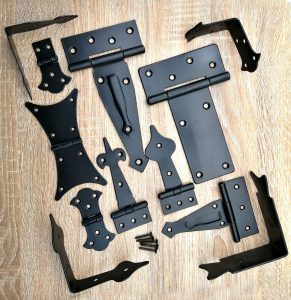
What a Hinge Is Actually Doing
People think of hinges as simple joining pieces. In reality, they are load-bearing components carrying the full weight of a door every single time it moves.
That load does not distribute itself neatly. The top fixing takes the most strain. The bottom takes the least. Every cycle puts stress through the screws, through the timber, and through the metal itself. Get the count wrong and you will see it eventually – one that starts dropping at the latch side, screws that keep working loose, or that classic scraping sound along the floor that arrives quietly and then never quite goes away.
Getting it right from the start costs almost nothing extra. Getting it wrong costs you a rehang.
The 3 Things That Settle the Question:
- Height
Height is where every calculation starts. The taller the door, the longer the lever arm between the top fixing and the latch side. That leverage puts more rotational force on the top mounting – and one extra fixing point makes a significant difference in managing it.
The UK joinery trade generally works to this guide:
- Up to 1981mm – 2 hinges minimum, though 3 has become common practice even at standard height
- 1981mm to 2286mm – 3 as the minimum
- Over 2286mm – 3 at minimum, with 4 depending on weight and type of hinge standard or heavy-duty
Older properties catch people out here. Victorian and Edwardian homes often run taller internally – they look ordinary until you measure and realise they sit comfortably in the three-hinge bracket.
When in doubt, go one up. The price difference between two and three hinges is negligible. The cost of rehanging something that has dropped and taken the frame with it is not.
- Weight
Height sets your baseline. Weight is what moves you above it.
A standard hollow-core option – the lightweight kind common in new-builds – sits comfortably on two good fixings at standard height. The moment you step up to solid timber, hardwood, fire-rated options, or anything with glass panels, the weight changes the picture considerably.
A rough guide:
- Hollow core up to 25kg – 2 fixings at standard height
- Solid softwood or light fire-rated, 25–40kg – 3 recommended
- Solid hardwood, heavy fire-rated, glazed panels, 40kg+ – 3 minimum, 4 for anything seriously heavy
- Any external door – always 3, regardless of weight
There is a simple field test if you do not have scales to hand. Pick up one end before it goes up. One hand lifts it easily – two fixings will likely do the job. Both hands and some effort – plan for three. Two people needed – three minimum, possibly four.
External doors deserve special mention. Beyond the weight, they deal with wind load every time they open in a breeze. A solid front entrance caught by a strong gust takes a sudden shock through the fixings that a light internal fitting never experiences. Three hinges are not optional here – it is just correct practice.
- How Hard the Door Works
This one rarely makes it into standard guidance, which is a shame because it genuinely matters.
A spare bedroom might see ten cycles on a busy day. A busy family kitchen might see sixty or more. A commercial entrance during a lunch service could see several hundred. Every cycle is mechanical stress. Over months and years, high-use fittings simply wear their fixings faster than identical fittings in quieter spots.
For most homes this is a fine-tuning factor rather than a deciding one. But for any fitting that genuinely works hard – a main hallway, a utility room, anywhere the whole household passes through dozens of times daily – an extra fixing is cheap insurance that pays for itself over the life of the installation.
Does Hinge Size Matter Too?
Yes, and it works alongside count rather than separately.
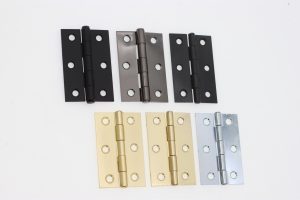
A 76mm (3 inch) option suits most standard internal work. Step up to 100mm (4 inch) for heavier internal applications and anything external. At 125mm you are into gates, barn doors, and anything with serious load demands.
Three undersized fixings on a heavy door will not perform as well as three correctly sized ones. The specification needs to suit the task – not just the number.
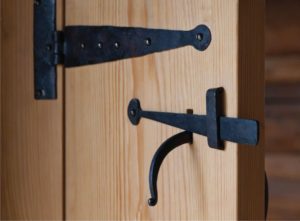
Spira Brass carries the full range across door hinges, Hook and Band, T-Hinges, and Decorative options for period properties – so you can match both size and count to what the situation actually demands.
The Quick Check Before You Buy
Run through these before settling on a number. Each one that applies pushes you toward the higher count:
- Over 1981mm tall
- Solid timber or glazed panels
- External fitting
- High traffic location
- Older property with heavy period style woodwork
- Fire door with a closer
Two or more of these together – start at three, not two.
Conclusion
Two works for light, standard-height internal doors that do not see heavy use. Most other situations – taller, heavier, busier, or outside – call for three. When the numbers are borderline, go up rather than down. The difference in cost is trivial. The difference in how things behave over the next ten years is not.
Browse the full range at Spira Brass: Door Hinges · Hook and Band · T-Hinges · Decorative Hinges · Ironmongery Kits · Handforged Latches & Hinges