You bought what looked like a perfectly good door knocker. A solid letter plate or a beautiful centre knob. They looked great on day one — polished, proud, and exactly what you wanted.
Then six months later, you notice the finish is dull. A year in, there’s discolouration around the edges. Two years on, the knocker has gone patchy, the letter plate stiffens every time it rains, and the knob has lost the look that made you choose it in the first place.
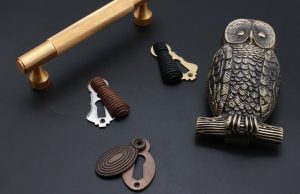
Sound familiar? You are not imagining it. Front door hardware genuinely does deteriorate faster than indoor hardware — and it is not random bad luck. There are very specific reasons why, and once you understand them, you will never buy exterior hardware the same way again.
The Front Door Is a Completely Different Environment
Here is the thing most people do not think about when they buy front door hardware: that knocker, that letterplate, that door knob — they are essentially living outside. Every single day.
Your indoor door handle sits in a climate-controlled room. It sees a steady temperature, no rain, no UV, no wind-driven grit. It is touched a handful of times a day and otherwise left alone.
Your front door hardware is a different story entirely.
The 5 Reasons Front Door Hardware Fails Faster
1. Rain and Moisture – Every Single Day
n the UK, rain is not an occasional visitor. It is a permanent resident. And every time it rains, your front door hardware gets wet – not just on the surface, but in the joints, around the fixing screws, inside the letterplate flap mechanism, and along the edges where the finish is thinnest.
Water finds its way into every gap. And when it sits in those gaps – even briefly – it begins the process of corrosion from the inside out. The outside of the hardware may still look acceptable while the mechanism inside is already rusting, stiffening, or weakening.
This is why a letterplate that opens smoothly in summer can feel stiff and resistant by winter. It is not the cold – it is accumulated moisture damage that has been building since the day it was installed.
What this means for your hardware choice: Any front door fitting needs to be made from a material that resists moisture at its core – not just coated on the outside. Solid brass, lacquered brass, and hot-dip galvanised iron are materials that handle moisture far better than thin-plated zinc alloys or hollow chrome fittings.
Explore our Front Door Hardware range – designed and finished specifically for external conditions.
2. UV Exposure – The Silent Finish Killer
Most people are surprised by this one. UV light from the sun is one of the most aggressive enemies of surface finishes – and your front door faces it directly, often for hours every day.
UV rays break down the molecular structure of lacquers, powder coatings, and plated finishes over time. The result is fading, chalking, and a patchy, bleached-out appearance – particularly on south and west-facing doors that get the most direct sun.
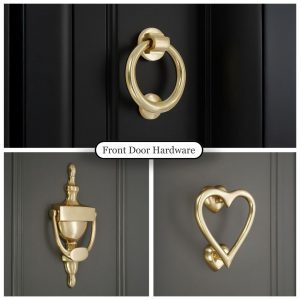
Indoor hardware never sees UV. That is why a cheap interior handle can look passable for years while the same hardware on a front door looks aged within a season.
What this means for your hardware choice: Finishes like lacquered brass, beeswax coated iron, or black powder coat over zinc-primed iron hold up significantly better under UV than standard plated finishes. They are designed to withstand the conditions your front door actually faces.
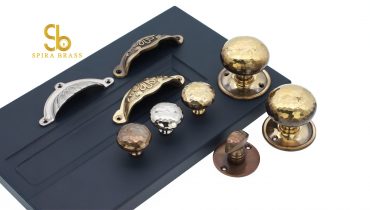
Browse our Door Knockers and Centre Door Knobs – finished to endure outdoor exposure without losing their character.
3. Thermal Expansion and Contraction
This one works slowly, but it is relentless. Metal expands when it is warm and contracts when it is cold. Your front door hardware goes through this cycle every single day – warming up in daylight, cooling down at night, and in winter going through more dramatic swings several times across a single day.
Over months and years, this repeated expansion and contraction does real damage. It loosens fixing screws as the metal shifts around them. It cracks thin finishes at the edges where movement concentrates. It stresses the joints between moving parts – particularly in letterplates and door knockers – eventually causing them to loosen, bind, or fail.
Indoor hardware sits at a relatively stable temperature. It simply does not experience this mechanical stress in the same way.
What this means for your hardware choice: Hardware designed for external use needs thicker metal sections and more robust fixing points that can absorb this movement without working loose. It also needs a finish that has some natural flexibility – which is why beeswax coatings and certain lacquers outperform brittle plated finishes in external conditions.
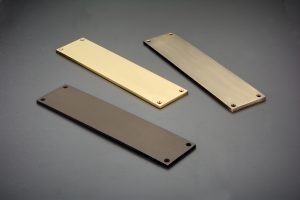
See our Finger Plates & Letter Plates – built with the mechanical robustness that exterior hardware demands.
4. Salt Air, Pollution, and Airborne Contaminants
If you live near the coast, you already know about salt air. It accelerates corrosion dramatically – what might take three years to develop inland can appear within three months near the sea.
But even well inland, urban air carries pollutants, traffic particulates, and airborne chemicals that settle on exterior surfaces and react with metal finishes. Rain washes some of it off, but also drives some of it into the crevices of your hardware where it continues to react.
Your indoor handles see none of this. The air inside your home is filtered through walls, ceilings, and floors. It is incomparably cleaner than the air your front door hardware breathes all day.
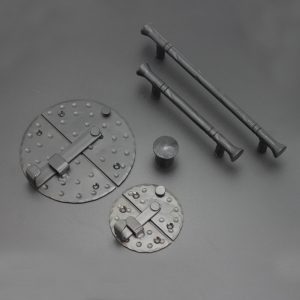
What this means for your hardware choice: In coastal or urban environments especially, the base material matters enormously. Solid brass is naturally more corrosion-resistant than most alternatives. Our Blacksmith Range uses a zinc primer coat beneath UV colour fast the black powder coat – specifically to create a barrier against corrosion before the decorative finish is even applied. It is the kind of layered protection that outdoor hardware actually needs.
5. High-Use Mechanical Stress
Your front door is used more than any other door in the house. Every person who visits, every delivery, every time a family member leaves or returns – it all goes through the front door. A busy household might use the front door 20 to 30 times a day.
That means the door knocker gets struck, the letterplate gets pushed, the door knob gets gripped and turned, and the lock gets engaged and released – hundreds of times every week. Under load. In all weathers.
Compare that to a bedroom door handle, which might be used six to ten times on a normal day and sits in still, temperate air in between. The mechanical demand is simply not comparable.
What this means for your hardware choice: Front door hardware needs mechanisms that are engineered for repeated use under real-world conditions – not decorative fittings that look the part but are not built for it. The weight of the fitting, the quality of the internal spring mechanisms, and the robustness of the fixing points all matter far more on a front door than anywhere else in the house.
Explore our full Front Door Security range – made to perform under exactly these conditions.
The Real Problem: Most People Buy Indoor-Grade Hardware for an Outdoor Job
Here is what ties all of the above together. The most common reason front door hardware fails prematurely is not bad luck – it is that people buy hardware rated for interior use and install it in one of the most demanding environments a piece of metal can live in.
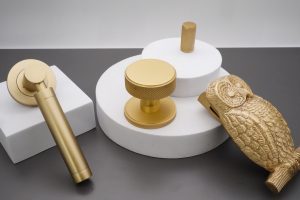
Many decorative hardware ranges – particularly budget options – are designed, tested, and finished for interior conditions. The plating is thin. The base metal is lightweight. The finish is not UV-stabilised. And the internal mechanisms are not designed to cope with temperature cycling or moisture ingress.
They look identical in the packaging. The difference only becomes apparent after six months on a front door.
What to Look for When Buying Front Door Hardware
Before you buy anything for your front door, ask these questions:
Is the base material solid or hollow? Solid brass and solid iron hold up. Hollow zinc alloy does not – at least not for long.
What is the finish, and is it rated for exterior use? Lacquered brass, black powder coat over zinc primer, beeswax-coated iron, and hot-dip galvanised finishes are genuinely exterior-grade. Thin chrome plate and standard electroplating are not.
Does the product have any external or weather-resistance specification? Quality exterior hardware will state it. If the listing says nothing about outdoor suitability, assume it is not.
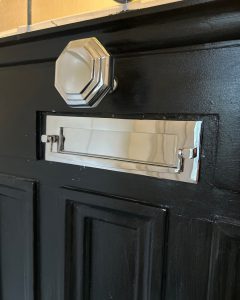
Are the fixing points substantial? Lightweight backplates with small, closely spaced screw holes will work loose with thermal movement. Look for solid, well-spaced fixing points designed to stay tight.
How Spira Brass Approaches Front Door Hardware
At Spira Brass, we make a clear distinction between what we produce for interior use and what we specify for the front door. Our exterior hardware is finished with protection layers designed for the actual conditions – lacquered coatings on brass collection, zinc primer plus black powder coat on our Blacksmith Range iron products, and beeswax coatings on handforged pieces.
Every product in our front door collection is built to be seen – and to stay looking the way it looked on day one, not just for a season but for years.
You can explore the full range below:
Conclusion
Your front door hardware works harder than any other hardware in your home. It faces rain, UV, salt air, pollution, temperature swings, and daily mechanical use – simultaneously, year round. Indoor hardware simply does not face these conditions.
The solution is not to accept that front door hardware has a short life. It is to choose hardware that is genuinely built for where it is going to live.
Buy for the outside, not for the showroom. Your front door deserves better than hardware that starts failing before winter is out.