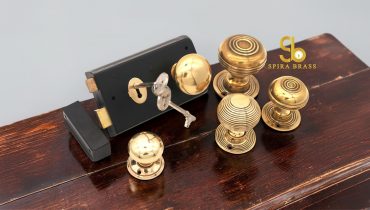
There is a particular kind of frustration that comes from revisiting a project two years after handover. Everything looks right – the colors have settled, the furniture is worn nicely, the client has made it their own. And then your eye lands on the door handle. The finish has gone flat or worse, patchy. And you remember making that specification in a hurry because the budget was tight or the deadline was close.
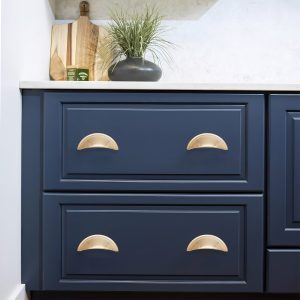
Finish selection does not get talked about enough in design circles. Everyone has opinions on paint, on fabric, on flooring. Hardware finishes tend to get picked late in the process, often under pressure, and that is exactly when the wrong calls get made. This is a checklist I wish someone had handed me earlier – not a catalogue rundown, but an honest look at what performs, what demands more of your client than they signed up for, and what to specify when the brief pulls in different directions.
Polished Brass: Commit to It or Leave It Alone
Polished brass is genuinely beautiful and genuinely demanding. There is no middle ground with it.
The unlacquered version – which is the one worth specifying if you want real depth and character – will shift over time. Heavy contact areas go lighter. Low-traffic surfaces darken. That slow evolution is either the whole point or a complete nightmare, depending on the client sitting across from you. Before you put it on a schedule, have that conversation. Some clients will love the idea of hardware that develops a story. Others will ring you in eight months asking why their handles look uneven.
Lacquered polished brass holds its look longer and needs nothing more than a soft cloth. You lose some of the warmth and depth but you gain predictability. For clients who entertain a lot, have young children, or simply want things to look the same in five years as they did on day one – lacquered is the honest recommendation.
Where polished brass really earns its place is in schemes with marble, dark painted joinery, or raw stone. The warmth it brings into those environments is hard to replicate with anything else.
Aged Brass: The One That Does the Work Quietly
If I could only specify one finish across a broad range of residential projects, aged brass would be a serious contender.
It arrives already looking like it has been there a while, which on any period or heritage project is an enormous advantage. The recessed areas are darker, the raised surfaces catch the light – and because it already looks lived in, it continues to look right as actual use adds to that story. Fingerprints do not show the way they do on polished surfaces. It does not need polishing. It does not react dramatically to condensation or humidity.
The aged brass range at Spira Brass works particularly well on country houses, older cottages, and any project where the client has used warm neutrals, natural textiles and reclaimed or heavily grained timber. It does not fight the materials around it. It just sits there looking like it belongs, which is ultimately what good hardware should do.
Antique and Aged Bronze: For Rooms That Are Meant to Feel Heavy
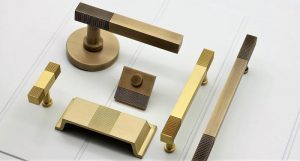
Bronze finishes are not for every project and they are not meant to be. Where aged brass is warm and approachable, antique is darker, more brooding – closer to the colour of old leather or dark wood than to anything bright or reflective.
It works in dining rooms with deep wall colours. Libraries. Studies with floor-to-ceiling shelving and reading chairs. Spaces where the mood is deliberately settled and the palette runs dark throughout. Specify it in a light-filled, neutral Scandi scheme and it looks like a mistake. Specify it in a room where someone has used Farrow and Ball’s Railings or Studio Green on the walls and it looks completely inevitable.
This is a finish that rewards confidence in the brief. If the room is going dark, go dark with the hardware too.
Handforged Iron: Only When It Is Genuinely Right
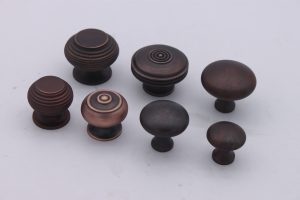
The handforged iron range is one of those things that either fits perfectly or sticks out completely. There is no in-between.
Barn conversions, rural properties with exposed beams, Arts and Crafts houses, farmhouse kitchens – this is where handforged ironwork belongs. The surface variation, the slightly uneven edges, the honest marks of the making process – all of that reads as completely authentic in those environments. Put the same hardware in a clean, white-walled London flat and it looks like a prop.
One practical note for the client brief: iron in high-moisture rooms needs occasional treatment with a light wax or oil to stay in good condition & our products already comes with a beeswax coating which makes the iron moisture proof and prevents it from getting corrode.
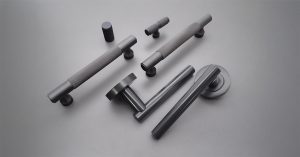
Matt Black: Still Works, but Stop Defaulting to It
Three or four years ago, matt black was everywhere. Kitchen showrooms, hotel bathrooms, editorial shoots – it became the shorthand for contemporary design in the same way that brushed chrome was in the early 2000s. That level of saturation tends to date things.
Used deliberately, matt black hardware is still sharp and effective. Industrial spaces, bold monochrome schemes, dark cabinetry – it reads as intentional in those contexts. The issue arises when it gets specified as a default rather than a decision.
The one maintenance point worth flagging: matt black surfaces show dust more than clients expect. It looks exceptional on the day the photographer comes. After two weeks of normal life it needs attention. Worth mentioning before you finalise the schedule.
The Thing That Ties It All Together
Whatever finish you land on, the single most important thing is running it consistently. Handles, hinges, escutcheons, bathroom accessories, cabinet hardware – when the same finish appears throughout a property in a coherent way, the scheme feels resolved. When it does not, something feels slightly off even if nobody can identify exactly what.
Spira Brass carries all of the above finishes across their full architectural hardware range, which makes cross-room consistency straightforward to achieve. Samples are available through their stockist network across the UK – worth ordering before you finalise anything, because finish colours on screen and in person are rarely the same thing.